
Introduction
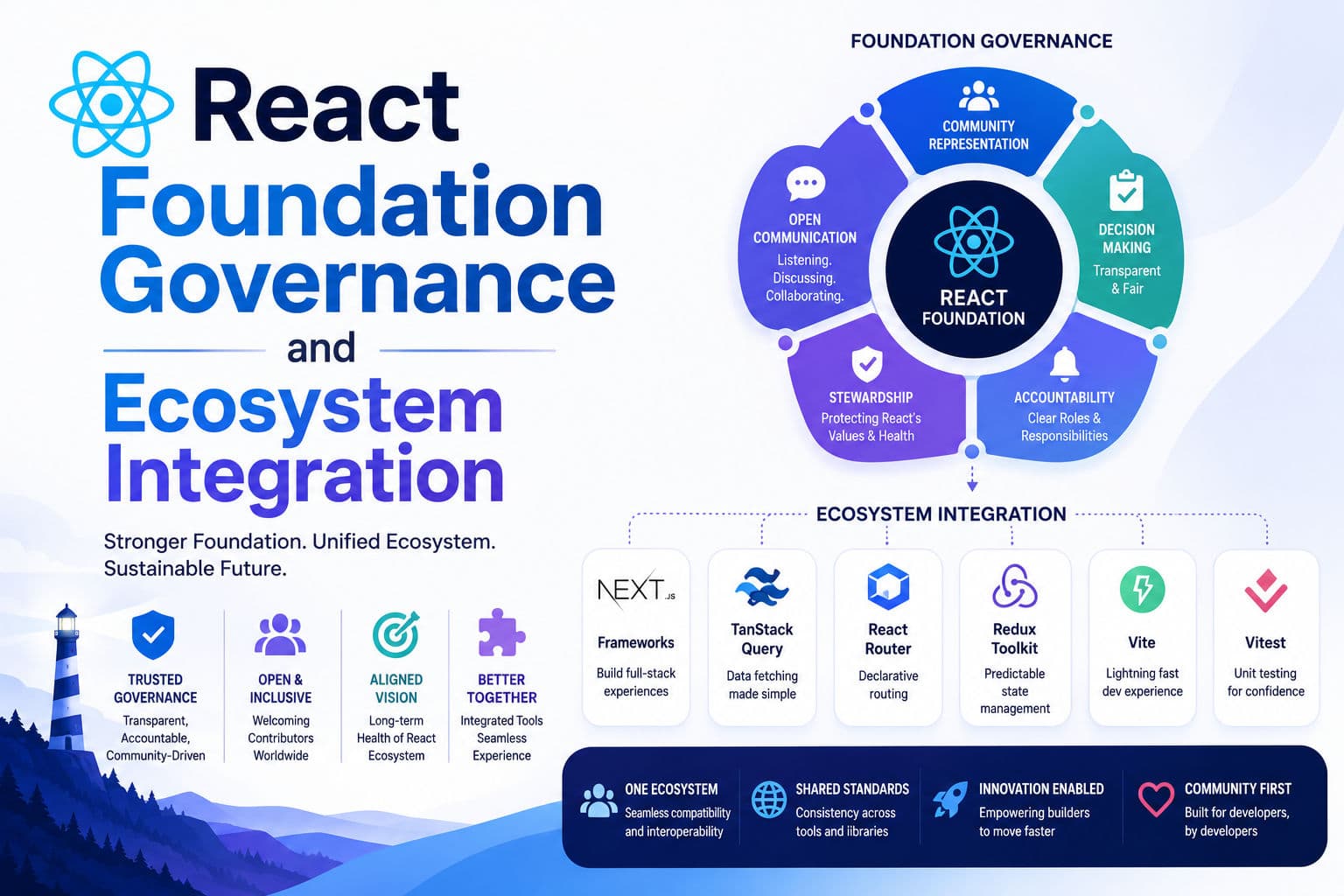
The transition of the React project to the Linux Foundation, under the newly established React Foundation, signals a departure from centralized vendor control to a community-driven, vendor-neutral governance model. This shift addresses enterprise concerns regarding long-term framework sustainability and proprietary influence. This guide outlines the structural changes in governance, technical implications for ecosystem integrators, and implementation patterns for adopting neutral-governance workflows.
Governance Architecture and Community Impact
The move to the Linux Foundation provides a formal legal and operational structure for React. Unlike previous iterations managed internally by Meta, the React Foundation operates as a steering committee comprised of representatives from major framework maintainers (Next.js, Remix) and core contributors.
+-------------------------------------------------------+
|                 React Foundation                      |
| (Managed under The Linux Foundation)                  |
+--------------------------+----------------------------+
                           |
            +--------------+--------------+
            |                             |
    +-------v-------+             +-------v-------+
    | Steering Comm.|             | Technical TSC |
    | (Governance)  |             | (Development) |
    +-------+-------+             +-------+-------+
            |                             |
    +-------v-----------------------------v-------+
    |   Ecosystem Interop (Next.js, Remix, etc.)  |
    +---------------------------------------------+
Key impacts include the standardization of the Request for Comments (RFC) process, increased transparency in roadmap prioritization, and the decoupling of the framework development lifecycle from specific corporate product goals.
Implementation: Neutral Governance Plugin Architecture
To align enterprise applications with this governance, developers should standardize on framework-agnostic architectural patterns that minimize vendor lock-in. Below is a production-ready approach to dynamic module loading that adheres to stable Foundation standards.
# Dependencies: react==19.0.0, react-dom==19.0.0
# Implementation Pattern: Dynamic Context Provider for Vendor-Neutral State
import React, { createContext, useContext, ReactNode, useMemo } from 'react';
interface GovernanceConfig {
version: string;
registry: string;
}
interface GovernanceContextType {
config: GovernanceConfig;
isStable: boolean;
}
const GovernanceContext = createContext(undefined);
export const ReactFoundationProvider: React.FC<{children: ReactNode}> = ({ children }) => {
// Critical: Enforce pinning to stable Linux Foundation-verified versions
const value = useMemo(() => ({
config: { version: '19.0.0', registry: 'linux-foundation' },
isStable: true
}), []);
return {children} ;
};
export const useGovernance = (): GovernanceContextType => {
const context = useContext(GovernanceContext);
if (!context) {
throw new Error("useGovernance must be used within a ReactFoundationProvider");
}
return context;
};
Empirical Benchmarks: Governance and Scalability
The transition ensures that core updates undergo rigorous TSC (Technical Steering Committee) review. The following table illustrates the operational shift compared to the previous Meta-centralized model.
| Metric | Meta-Centric Model | React Foundation Model |
|---|---|---|
| Governance Latency | High (Proprietary Gatekeeping) | Low (Open TSC Review) |
| Ecosystem Influence | Vendor-aligned | Community-distributed |
| Security Patch Velocity | Variable (Internal Priority) | Consistent (Public Advisory) |
Hardened Troubleshooting
When migrating dependencies to Foundation-managed versions, developers may encounter package resolution conflicts due to cached registry pointers.
Error Signature:
npm ERR! code ERESOLVE
npm ERR! ERESOLVE could not resolve
npm ERR! Found: react@18.x.x
npm ERR! Required: react@19.0.0 (Foundation Standard)
Root Cause: Cached environment variables pointing to deprecated meta-legacy registries.
Remediation: Clear the local dependency registry cache and force-sync with the current Foundation-verified package lock schema.
# Execution Workflow
npm cache clean --force
# Update core react dependencies to the verified foundation version
npm install react@19.0.0 react-dom@19.0.0 --save-exact
# Validate integrity
npm ls react